

A busy restaurant can still be an unprofitable restaurant.
That is one of the most important lessons I learned from being on both sides of the numbers, first as a franchise owner and now as a CPA working with business owners.
Sales matter, of course. But increasing revenue does not automatically create a healthier business. If food costs are creeping upward, labor is not aligned with sales, cash is constantly tight, or operating expenses are growing faster than revenue, higher sales can hide problems rather than solve them.
Experienced restaurant bookkeepers look beyond the amount of money coming through the register. Good bookkeeping helps you understand what happens to that money after the sale and, ultimately, how much of it the business actually keeps.
That distinction can change the way you run your restaurant.
Sales Are Only the Starting Point
Restaurant owners naturally pay close attention to sales.
You see the POS totals every day. You know whether Friday night was busy. You know when a promotion brought people through the door. If you operate multiple locations, you probably compare their sales regularly.
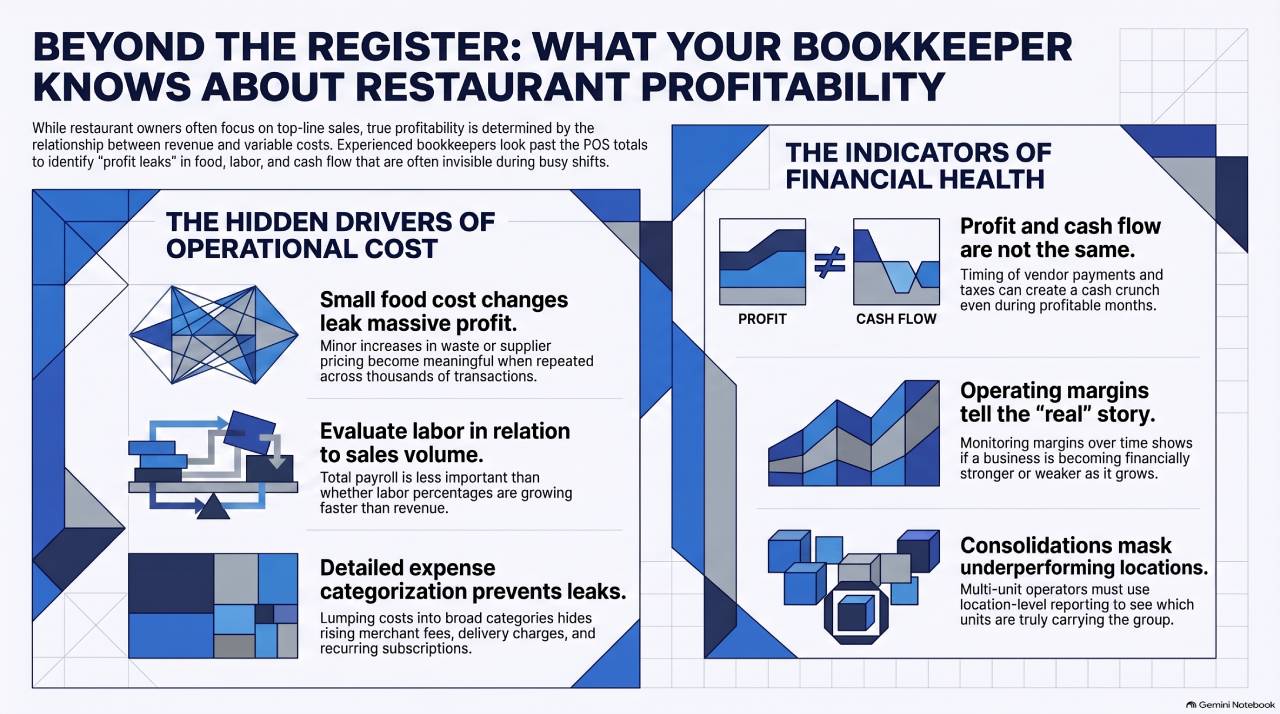
But sales tell you how much business you did. They do not tell you how well you performed financially.
Consider two restaurant locations generating similar monthly revenue.
One might have:
- Better control over food waste
- More efficient employee scheduling
- Lower overtime
- Better vendor pricing
- Higher average checks
- Stronger operating margins
On paper, their top-line sales may look almost identical. At the bottom line, they can be very different businesses.
That is why effective bookkeeping for restaurants should give you more than an accurate sales number. It should help you see the relationship between revenue, costs and profit.
1. Food Cost Problems Can Hide Behind Strong Revenue
Food is one of the most significant and variable expenses in a restaurant.
When sales are strong, it is easy to overlook relatively small increases in ingredient costs, waste or purchasing. But small percentage changes become meaningful when they are repeated across thousands of transactions.
Your bookkeeping should make it possible to monitor food costs consistently and investigate unexpected changes.
- If food costs are increasing, you need to ask why.
- Have supplier prices increased?
- Are portion sizes inconsistent?
- Has waste increased?
- Is inventory being managed properly?
- Are certain menu items no longer generating an acceptable margin?
The books cannot tell you why a kitchen is wasting ingredients. But they can show you that there is a financial pattern worth investigating.
That is an important distinction.
A good bookkeeper for restaurants helps make sure the financial data is categorized accurately enough that management can identify these changes. Once you have reliable numbers, you can start asking better operational questions.
2. Labor Should Be Viewed in Relation to Sales
Looking at total payroll expense alone does not give you enough information.
A restaurant can spend more on labor this month than last month and still be operating efficiently if sales increased at a greater rate. Conversely, payroll could remain relatively stable while falling sales cause labor to consume a much larger percentage of revenue.
That is why percentages and trends matter.
When you regularly compare labor costs with sales, you can begin identifying patterns such as:
- Consistent overstaffing during certain shifts
- Increasing overtime
- Labor growing faster than revenue
- Significant differences between locations
- Seasonal staffing changes that are hurting margins
This is where accurate bookkeeping becomes useful for management rather than simply recordkeeping.
Your numbers should help you decide whether staffing levels make sense based on what is actually happening in the business.
3. Profit and Cash Flow Are Not the Same Thing
One of the most frustrating situations for a restaurant owner is seeing a profit on the income statement while wondering why there never seems to be enough cash in the bank.
The two numbers measure different things.
You can have a profitable month and still experience cash pressure because of the timing of vendor payments, payroll, debt payments, tax obligations, equipment purchases or other cash outflows.
This is why experienced restaurant bookkeepers pay attention to cash movement as well as profitability.
Ask yourself:
- Could the business comfortably handle an unexpected equipment repair?
- Are you regularly waiting for the next strong weekend before paying vendors?
- Do tax payments create a cash crunch every quarter?
- Are you using credit to cover normal operating expenses?
- Do you know what major cash commitments are coming over the next several weeks?
If you cannot answer those questions confidently, the issue may not be a lack of sales. It may be a lack of financial visibility.
4. Your Operating Margin Tells a Bigger Story
Revenue can make a restaurant look impressive from the outside. Margin tells you more about what is happening underneath.
Your operating margin shows how much income remains after the expenses required to operate the business.
More importantly, monitoring that margin over time can help you see whether the restaurant is becoming financially stronger or weaker.
Imagine sales increase by 10%, but operating expenses increase by 15%.
Revenue grew. The business got busier. Your team probably worked harder.
But did the restaurant actually become more profitable?
That is the question owners need to ask.
When a restaurant accounting firm or bookkeeping team provides consistent reporting, you can compare margins month to month, year over year and, for multi-unit operators, location to location.
Those comparisons often reveal more than a single monthly profit figure.
5. Small Expense Changes Become Large Profit Leaks
Restaurant margins leave little room for expenses to go unnoticed.
A slightly higher merchant processing fee may not seem significant.
Neither does a modest increase in cleaning supplies, delivery platform charges, utilities, repairs or small recurring subscriptions.
Individually, these expenses can appear harmless. Collectively, they can gradually reduce profitability.
This is one reason your chart of accounts and expense categorization matter.
If too many expenses are lumped into broad categories, you lose visibility.
Good bookkeeping for restaurants creates enough consistency to compare expenses over time and identify categories that are moving in the wrong direction.
The goal is not to question every dollar spent.
It is to recognize patterns early enough to do something about them.
6. Multi-Unit Operators Need Location-Level Visibility
Once you own more than one restaurant, consolidated numbers are no longer enough.
Suppose you own four locations and the group is profitable overall.
That sounds positive.
But what if one location is generating exceptional margins while another is consistently underperforming?
A consolidated profit and loss statement can hide that difference.
Multi-unit operators need reporting that allows them to compare locations using consistent financial categories and performance measures.
You should be able to see differences in:
- Food costs
- Labor
- Revenue
- Operating expenses
- Cash flow
- Profitability
Then you can ask why those differences exist.
Maybe one manager schedules labor more effectively.
Maybe one location has excessive waste.
Maybe another has a stronger product mix.
Maybe rent or occupancy costs make one location structurally less profitable.
This is where financial reporting starts becoming a management tool.
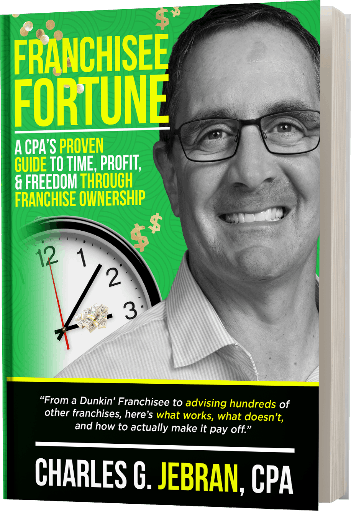
Franchisee Fortune:
A Book for Franchise Owners Who Want Profit, Clarity, and Control
7. Accurate Books Give You Time to React
There is another issue restaurant owners sometimes overlook: timing.
A perfectly accurate report delivered months after the fact has limited operational value.
You cannot go back and change last quarter’s staffing schedule.
You cannot undo months of excessive food waste.
You cannot renegotiate yesterday’s purchasing decision.
Current bookkeeping gives you a much better opportunity to identify trends while you can still influence them.
That is why the value of restaurant bookkeepers is not simply having clean records at tax time.
You want reliable financial information throughout the year.
The sooner you see a problem developing, the more options you generally have for addressing it.
What Should Restaurant Owners Expect From Their Bookkeeping?
At a minimum, you should be able to look at your financial information and understand:
- How much the restaurant earned
- Where the money went
- What happened to food and labor costs
- Whether operating margins are improving or declining
- How much cash the business has available
- Whether major expenses are changing
- How individual locations are performing
- Whether the business is actually becoming more profitable
If your bookkeeping cannot answer those questions, you may technically have accurate books without having useful financial visibility.
And those are not the same thing.
From Bookkeeping to Better Decisions
I have owned and operated franchises myself, so I understand how easy it is to become absorbed in day-to-day operations.
There is always something demanding your attention: employees, customers, vendors, inventory, equipment, scheduling and dozens of decisions that cannot wait.
That is exactly why your financial reporting needs to be useful.
You should not have to become an accountant to understand whether your restaurant is making money.
The role of strong bookkeeping is to organize the financial side of the business so you can see what is happening, ask the right questions and make decisions based on reliable information.
As the business grows, that foundation becomes even more important. Good bookkeeping can support budgeting, forecasting, tax planning and higher-level financial advisory because those decisions are only as reliable as the numbers behind them.
Better Sales Are Good. Better Visibility Is Better.
Restaurant profitability is rarely determined by one dramatic decision.
More often, it comes from consistently understanding and managing the percentages behind the business.
- Food cost.
- Labor.
- Operating expenses.
- Cash flow.
- Margins.
These are the numbers experienced restaurant bookkeepers pay attention to because they help explain what sales alone cannot.
At Jebran & Abraham, P.C., our team works with restaurant owners and franchise operators who want more financial clarity from their books. Our approach combines accounting experience with the practical perspective that comes from having owned and operated businesses ourselves.
If your restaurant is generating revenue but you are still asking, “Where is the money going?”, it may be time to take a closer look at what your financial reporting is telling you.
Talk to our team about bookkeeping and financial support for your restaurant or franchise.
FAQs
What does a restaurant bookkeeper do?
A restaurant bookkeeper records and organizes financial activity such as sales, vendor expenses, payroll-related transactions and operating costs. More importantly, accurate restaurant bookkeeping creates reliable financial reports that owners can use to monitor profitability, cash flow and changes in major expense categories.
Why is bookkeeping for restaurants different from general bookkeeping?
Restaurants typically have high transaction volumes and several important variable costs, including food, labor, inventory, merchant fees and delivery expenses. Bookkeeping for restaurants needs to categorize these transactions consistently so owners can understand how operational changes affect margins and profitability.
How can restaurant bookkeepers help improve profitability?
Restaurant bookkeepers provide the accurate, current financial data needed to identify changes in food costs, labor, operating expenses, cash flow and margins. They do not control those costs directly, but their reporting can help owners recognize problems sooner and make better-informed operational decisions.
How often should restaurant owners review their financial reports?
Restaurant owners should monitor key operational information frequently and review formal financial reports consistently throughout the year. Waiting until tax season makes it difficult to identify and respond to profitability issues while they are happening.
When should I hire a bookkeeper for my restaurant?
Consider working with a bookkeeper for restaurants when managing the books is taking significant time away from operations, financial reports are consistently delayed, accounts need cleanup, or you cannot confidently explain where the restaurant’s money is going.
Should a growing restaurant use a bookkeeper or a restaurant accounting firm?
The right level of support depends on the complexity of the business. Basic bookkeeping may be sufficient for recording transactions, but a growing or multi-unit operation may benefit from a restaurant accounting firm that can connect bookkeeping with tax planning, financial reporting, forecasting and advisory services.
What does a restaurant bookkeeper do?
A restaurant bookkeeper records and organizes financial activity such as sales, vendor expenses, payroll-related transactions and operating costs. More importantly, accurate restaurant bookkeeping creates reliable financial reports that owners can use to monitor profitability, cash flow and changes in major expense categories.
If you are unsure what you should actually be looking for in those reports, read our guide on How to Read a Restaurant Financial Report: Key Metrics That Matter.
How can restaurant bookkeepers help improve profitability?
Restaurant bookkeepers provide the accurate, current financial data needed to identify changes in food costs, labor, operating expenses, cash flow and margins. They do not control those costs directly, but their reporting can help owners recognize problems sooner and make better-informed operational decisions.
Bookkeeping is only one part of the financial picture. We explore additional ways restaurant owners can strengthen their financial operations in Restaurant Accounting Solutions That Improve Profitability.
Why is bookkeeping for restaurants different from general bookkeeping?
Restaurants typically have high transaction volumes and several important variable costs, including food, labor, inventory, merchant fees and delivery expenses. Bookkeeping for restaurants needs to categorize these transactions consistently so owners can understand how operational changes affect margins and profitability.
For a closer look at how accounting can help restaurant and franchise owners manage two of their biggest costs, read How Restaurant Accounting Firms Help Franchise Owners Improve Food Cost Control, Labor Efficiency, and Profitability.
What financial metrics should restaurant owners monitor?
Restaurant owners should understand more than revenue alone. Food costs, labor costs, gross profit, operating margin and cash flow can all provide important insight into how efficiently the restaurant is operating and whether sales are translating into profit.
Our article How to Read a Restaurant Financial Report: Key Metrics That Matter explains these numbers in more detail and how restaurant owners can use them to make better business decisions.
When does a restaurant need more than bookkeeping?
As a restaurant grows, accurate bookkeeping remains essential, but owners may need more forward-looking financial support. Budgeting, cash flow forecasting, profitability analysis, scenario planning and strategic financial guidance go beyond maintaining accurate books and can help owners make decisions about growth.
Learn more about this next level of financial support in What a Fractional CFO for Restaurants Sees That Most Owners Miss.
How should multi-unit restaurant owners manage their bookkeeping?
Multi-unit operators need to see both consolidated performance and what is happening at each individual location. Consistent bookkeeping makes it easier to compare revenue, food costs, labor, operating expenses and profitability across locations and identify where performance differs.
For franchise owners expanding beyond a single location, we cover this in more detail in Franchise Bookkeeping Services for Multi-Unit Owners: Managing Growth With Financial Clarity.
Should a growing restaurant use a bookkeeper or a restaurant accounting firm?
The right level of support depends on the complexity of the business. Basic bookkeeping may be sufficient for recording transactions, but a growing or multi-unit operation may benefit from a restaurant accounting firm that can connect bookkeeping with tax planning, financial reporting, forecasting and advisory services.
If you operate a franchise, working with professionals who understand the franchise model can also provide valuable context around royalties, multi-unit growth, tax planning and financial performance. Read Why Every Franchise Owner Should Work With a Franchise CPA to learn more.