

Every month, restaurant owners receive financial reports packed with numbers, percentages, and accounting terminology. Yet many glance at the top line, check whether they made money, and move on.
The problem is that a restaurant financial report is far more than a record of what happened last month. When you know how to interpret it, it becomes one of the most valuable management tools in your business.
Whether you own a single restaurant or manage multiple franchise locations, understanding your financial reports helps you identify opportunities, control costs, improve profitability, and make confident business decisions before small issues become expensive problems.
At Jebran & Abraham, P.C., we believe financial reporting should do more than satisfy tax requirements. It should provide the clarity you need to build a stronger, more profitable business.
Why Your Restaurant Financial Report Matters
Many restaurant owners focus almost exclusively on sales.
While increasing revenue is important, sales alone don’t determine whether your business is financially healthy.
Two restaurants can generate exactly the same revenue while producing completely different profits.
The difference usually comes down to how well the owner understands the numbers behind the business.
A comprehensive restaurant financial report helps answer questions such as:
- Are food costs increasing?
- Is payroll growing faster than revenue?
- Which locations are performing best?
- Is cash flow improving?
- Are expenses under control?
- Is the business becoming more profitable?
Instead of relying on instinct, you begin making decisions based on facts.
That’s the real value of quality restaurant financial reporting.
Start With Your Profit and Loss Statement
The Profit and Loss Statement (P&L), sometimes called an Income Statement, is usually the first report restaurant owners review.
It summarizes:
- Sales
- Cost of Goods Sold (COGS)
- Gross Profit
- Operating Expenses
- Net Profit
Rather than simply asking whether you made money, ask yourself:
- Did food costs increase?
- Did labor costs stay within target?
- Are operating expenses increasing?
- Is profitability improving month over month?
These trends often reveal much more than a single month’s profit.
Accurate Bookkeeping and Tax Services provide reliable financial information that allows these comparisons to become meaningful.
Without clean bookkeeping, your financial reports lose much of their value.
Food Cost Percentage Is One Of The Most Important Metrics
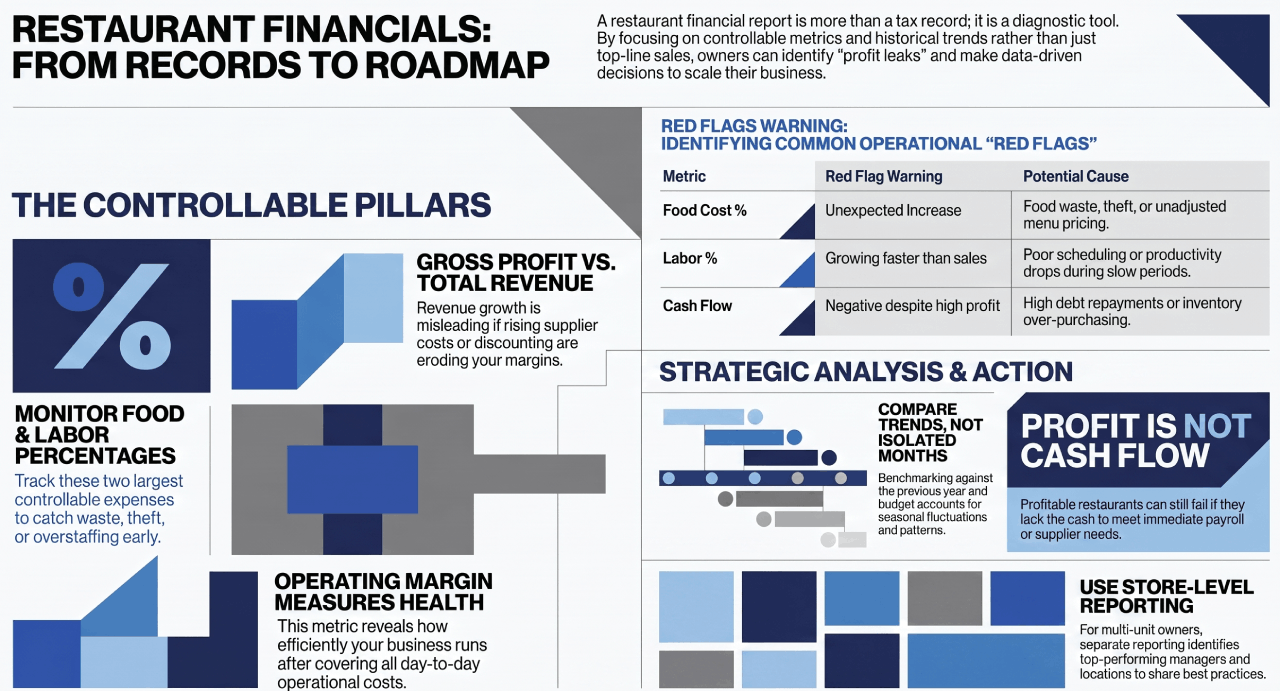
Food cost remains one of the largest controllable expenses in almost every restaurant.
Even a small increase can significantly reduce profitability.
When reviewing your restaurant financial statement, calculate your food cost percentage regularly and compare it against previous months.
Unexpected increases often point toward issues such as:
- Supplier price increases
- Food waste
- Poor inventory controls
- Incorrect portion sizes
- Theft
- Menu pricing that no longer reflects ingredient costs
Rather than treating food costs as a fixed expense, successful restaurant owners monitor them continuously.
Regular reviews make it easier to respond before profitability suffers.
If you’re looking to improve this area, our article on Margin Analysis Tips: Improve Pricing And Profitability With Better Insights explains how to identify hidden profit leaks throughout your business.
Monitor Labor Percentage Just As Closely
Labor usually represents the second largest controllable expense.
Hiring enough staff to provide excellent customer service is essential, but overstaffing can quickly reduce margins.
Your restaurant financial report should help you understand:
- Labor cost as a percentage of sales
- Overtime trends
- Productivity during slower periods
- Staffing efficiency across different locations
Rather than reviewing payroll only at the end of the month, successful operators monitor labor throughout the reporting period.
Small scheduling adjustments often create significant long-term savings.
Restaurant owners who combine labor analysis with operational data make far better staffing decisions than those relying purely on experience.
Gross Profit Tells You More Than Revenue Alone
Revenue often receives the most attention, but gross profit provides a much clearer picture of business performance.
Gross profit shows how much money remains after paying for food and beverage costs.
If revenue increases while gross profit declines, something needs attention.
Possible causes include:
- Rising supplier costs
- Discounting
- Increased waste
- Menu mix changes
- Portion inconsistencies
Tracking gross profit over time helps you understand whether sales growth is actually creating additional profit.
This is where consistent restaurant financial reporting becomes an incredibly valuable management tool rather than simply an accounting exercise.
Don’t Ignore Operating Expenses
Operating expenses quietly influence profitability every month.
These include expenses such as:
- Rent
- Utilities
- Insurance
- Marketing
- Repairs and maintenance
- Software subscriptions
- Professional fees
Many restaurant owners review these expenses individually rather than identifying long-term trends.
Monthly reporting allows you to spot gradual increases before they significantly affect profitability.
It also helps identify opportunities to negotiate supplier contracts or reduce unnecessary spending.
Financial visibility leads to better financial decisions.
Cash Flow Often Matters More Than Profit
One of the biggest misconceptions among business owners is believing that profitable businesses never experience cash flow problems.
Unfortunately, that’s simply not true.
A restaurant can report a healthy profit while struggling to pay suppliers, payroll, or loan repayments.
Your restaurant financial report should always be reviewed alongside your cash flow.
Healthy cash flow allows you to:
- Purchase inventory confidently.
- Invest in equipment.
- Expand operations.
- Manage seasonal fluctuations.
- Respond to unexpected expenses.
This is one reason many growing businesses benefit from CFO & Advisory Services, where financial reports become practical tools for planning rather than historical records.
Operating Margin Shows The Health Of Your Business
Your operating margin measures how much profit remains after covering the day-to-day costs of running your restaurant.
This metric brings together your food costs, labor expenses, and operating overhead to show how efficiently your business is operating.
While every restaurant is different, your operating margin should be reviewed consistently over time rather than in isolation.
Ask yourself:
- Is my operating margin improving?
- Are expenses growing faster than sales?
- Which locations consistently outperform the others?
- What operational changes improved profitability this month?
When you regularly review your restaurant financial statement, these trends become much easier to identify. Small improvements across several areas often produce far greater results than one major change.
Compare Performance Over Time, Not Just Month To Month
One month’s financial results rarely tell the whole story.
Restaurants naturally experience seasonal fluctuations, changing customer demand, and varying operating costs throughout the year.
That’s why every restaurant financial report should be compared against:
- Previous months
- The same month last year
- Budgeted performance
- Other restaurant locations (if applicable)
Looking at trends rather than isolated numbers helps you identify whether changes are temporary or part of a larger pattern.
For example, if labor costs have gradually increased over six months while sales have remained relatively flat, it’s a sign that scheduling practices may need attention.
Historical reporting provides valuable context that supports smarter operational decisions.
Multi-Location Restaurants Need Store-Level Reporting
For franchise owners and multi-unit operators, consolidated reports only tell part of the story.
Every location should have its own financial reporting so you can compare performance across your portfolio.
Store-level reporting allows you to identify:
- Which locations generate the strongest margins.
- Which stores have higher labor costs.
- Where food costs are increasing.
- Which managers consistently outperform others.
- Opportunities to share best practices across locations.
This level of visibility allows owners to solve problems before they affect the entire business.
If you’re managing multiple locations, our guide on Franchise Bookkeeping Services For Multi-Unit Owners: Managing Growth With Financial Clarity explains how consistent financial reporting supports sustainable growth.
Your Financial Reports Should Lead To Action
Many restaurant owners receive monthly reports, file them away, and never look at them again.
The most successful operators do the opposite.
Every financial report should lead to practical questions, such as:
- Should menu prices be adjusted?
- Are supplier costs increasing?
- Is staffing aligned with customer demand?
- Can unnecessary expenses be reduced?
- Is another location ready for expansion?
Financial reporting isn’t valuable because it tells you what happened.
It’s valuable because it helps you decide what to do next.
This is where experienced advisors can add significant value. Through CFO & Advisory Services, financial reports become a roadmap for improving profitability instead of simply satisfying accounting requirements.
Financial Reporting Supports Better Tax Planning
Many business owners think about taxes once a year.
The reality is that effective tax planning happens throughout the year, and it starts with accurate financial reporting.
Clean books and reliable monthly reporting help you:
- Estimate tax liabilities.
- Plan equipment purchases.
- Structure owner compensation.
- Prepare for business growth.
- Improve cash flow before tax deadlines.
Without accurate financial data, even the best tax strategy becomes difficult to implement.
That’s why many growing restaurant businesses combine quality bookkeeping with Tax Planning & Business Structuring to support both compliance and long-term financial performance.
Technology Makes Reporting Faster, But People Create Insight
Modern accounting software can generate reports in seconds.
What software can’t do is explain why your labor percentage increased, why margins declined, or whether it’s the right time to expand.
That’s where experienced professionals make the difference.
Strong restaurant financial reporting combines technology with practical business advice.
At Jebran & Abraham, P.C., we use modern accounting tools to provide timely information, but our real value comes from helping business owners understand what those numbers mean.
As a former Dunkin’ franchise owner, Charlie Jebran understands the operational realities behind the financial reports. He knows that every percentage point matters because he’s experienced the same challenges many restaurant owners face today.
That real-world perspective helps transform financial reports into practical business guidance.
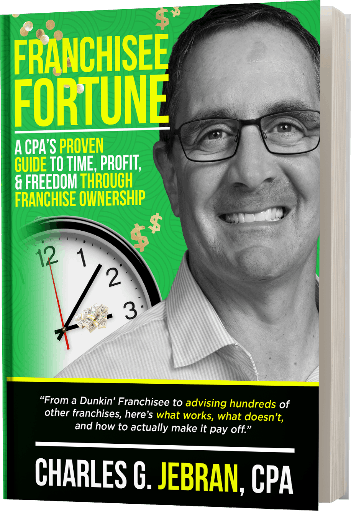
Franchisee Fortune:
A Book for Franchise Owners Who Want Profit, Clarity, and Control
Build A More Profitable Restaurant With Better Financial Visibility
The best restaurant owners don’t wait until year-end to review their finances.
They use their restaurant financial report throughout the year to monitor performance, identify trends, improve profitability, and make informed business decisions.
Understanding your numbers doesn’t require becoming an accountant. It requires having accurate financial information and the right guidance to interpret it.
When your bookkeeping, financial reporting, and advisory services work together, you gain far more than compliance. You gain the confidence to make better decisions that support long-term success.
If you’re looking for clearer financial reporting and practical insights that help your restaurant become more profitable, our team is here to help. Whether you’re operating a single location or managing multiple franchises, we can help you turn your financial reports into a valuable business tool.
Book A Call to discuss your business with our team, or visit our Contact Us page to learn how Jebran & Abraham, P.C. can help you build a stronger financial future.
Frequently Asked Questions
What is included in a restaurant financial report?
A typical restaurant financial report includes your Profit and Loss Statement, Balance Sheet, Cash Flow Statement, and supporting reports that track food costs, labor expenses, inventory, and profitability. Together, these reports provide a complete picture of your restaurant’s financial performance.
Why is restaurant financial reporting important?
Regular restaurant financial reporting helps owners identify trends, monitor costs, improve cash flow, and make informed business decisions. Rather than reacting to problems, you can address them early using accurate financial data.
Which financial metrics should restaurant owners monitor most closely?
Food cost percentage, labor percentage, gross profit, operating margin, inventory turnover, and cash flow are some of the most important metrics. Our article Restaurant Accounting Solutions That Improve Profitability explains how these metrics work together to improve financial performance.
How do restaurant accounting firms help owners understand financial reports?
Specialized firms don’t just prepare reports. They explain what the numbers mean and provide practical recommendations for improving profitability, labor efficiency, and food cost control. Learn more in How Restaurant Accounting Firms Help Franchise Owners Improve Food Cost Control, Labor Efficiency, And Profitability.
When should a restaurant hire a fractional CFO?
As your business grows, financial decisions become more complex. A fractional CFO can help with budgeting, forecasting, expansion planning, and improving profitability. Read What A Fractional CFO For Restaurants Sees That Most Owners Miss to learn when this level of support becomes valuable.
Why should franchise restaurants work with a CPA who understands franchising?
Franchise businesses face additional financial responsibilities, including royalties, multi-location reporting, and franchisor compliance. Our guide Why Every Franchise Owner Should Work With A Franchise CPA explains how industry-specific expertise helps owners avoid costly financial mistakes.
How can better financial reporting support restaurant growth?
Consistent reporting provides the information needed to evaluate expansion opportunities, improve operational performance, and compare multiple locations. If you’re planning to grow your franchise, read Franchise Accounting Services: The Biggest Financial Mistakes Franchise Owners Make to understand the financial challenges that often accompany expansion.