

Running a successful restaurant franchise isn’t just about serving great food or creating an exceptional customer experience. Long-term success depends on understanding the financial drivers behind your business and using them to make better decisions every day.
Many restaurant owners focus on increasing sales, but revenue alone doesn’t guarantee profitability. Rising food costs, labor expenses, inventory waste, and inconsistent pricing can quickly reduce margins without being immediately obvious.
This is where restaurant accounting solutions become far more valuable than traditional bookkeeping. Rather than simply recording transactions, they provide the financial visibility needed to identify problems early, improve operational efficiency, and increase profitability across every location.
For franchise owners and multi-unit operators, that visibility can mean the difference between constantly reacting to financial issues and confidently planning for sustainable growth.
Profitability Starts With Financial Visibility
You can’t improve what you can’t measure.
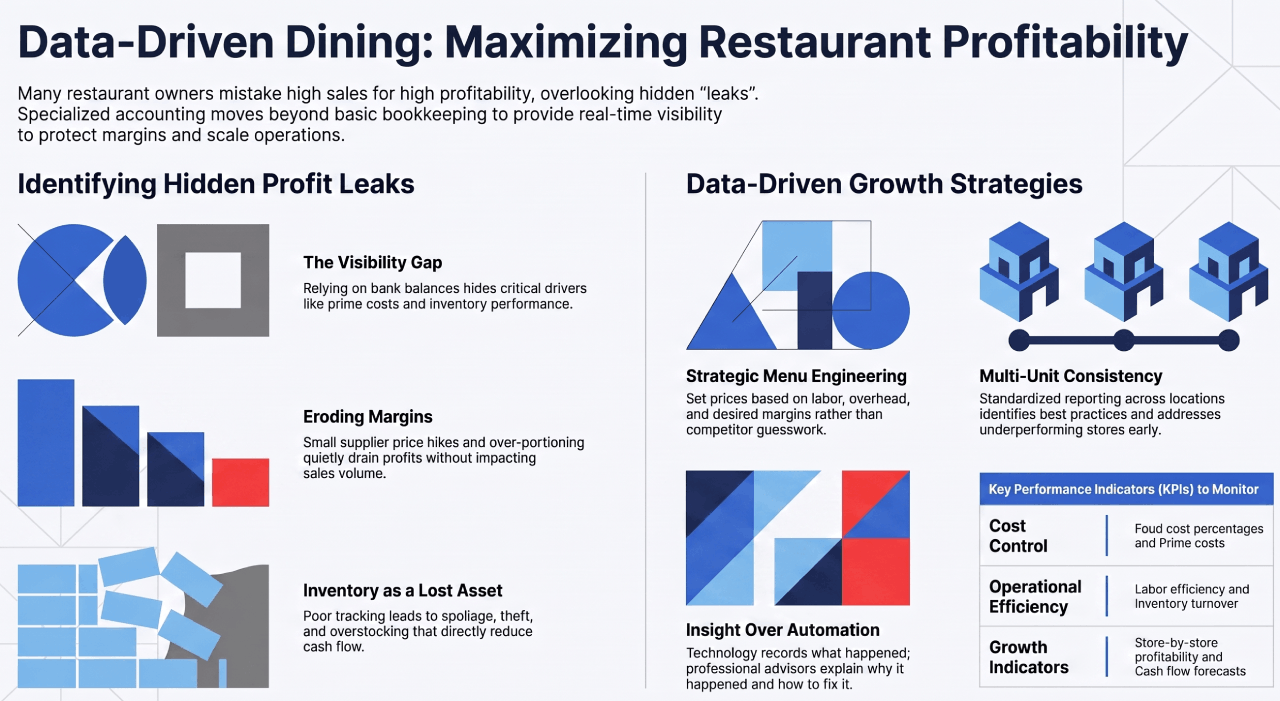
One of the biggest mistakes restaurant owners make is relying on bank balances or monthly sales figures to judge business performance. While those numbers are important, they rarely tell the complete story.
Strong restaurant accounting solutions provide real-time insight into:
- Food cost percentages
- Labor costs
- Prime costs
- Gross profit margins
- Cash flow
- Inventory performance
- Store-by-store profitability
When these numbers are monitored consistently, small issues become visible before they become expensive problems.
This is why professional Bookkeeping and Tax Services should provide more than reconciled accounts. They should give you meaningful reports that help you understand exactly where your money is going and where opportunities exist to improve profitability.
Margin Analysis Reveals Hidden Profit Leaks
Many restaurants appear busy every day yet still struggle to generate healthy profits.
Often, the problem isn’t sales. It’s margins.
Small increases in supplier pricing, excessive food waste, over-portioning, discounting, or menu items with poor profitability can quietly erode profits over time.
Regular margin analysis helps answer questions like:
- Which menu items generate the highest profit?
- Which products should be repriced?
- Are supplier costs increasing?
- Which locations consistently outperform others?
- Where are unnecessary expenses occurring?
Instead of relying on assumptions, you can make decisions backed by accurate financial data.
If you’re looking to better understand how to evaluate your margins, our guide on Margin Analysis: Improve Pricing And Profitability With Better Insights provides a deeper look into the numbers that matter most.
Inventory Management Has A Direct Impact On Profitability
Inventory is one of the largest assets in any restaurant business, but it’s also one of the easiest places for profits to disappear.
Poor inventory management can lead to:
- Food spoilage
- Theft
- Overstocking
- Stock shortages
- Increased purchasing costs
- Inaccurate financial reporting
Effective restaurant accounting services connect inventory data with your financial reports so you can identify unusual trends quickly.
For example, if food purchases continue increasing while sales remain stable, it’s a signal that something needs attention.
By reviewing inventory alongside your financial statements, restaurant owners gain much better control over food costs and purchasing decisions.
This proactive approach reduces waste while protecting profit margins.
Better Financial Reporting Leads To Better Decisions
Many business owners receive financial reports every month but rarely use them.
That’s usually because the reports are difficult to understand or don’t answer the questions owners actually have.
Good reporting should be practical.
Instead of simply producing a Profit & Loss statement, quality restaurant accounting solutions explain what the numbers mean and how they affect your business.
Useful reporting may include:
- Weekly sales trends
- Food cost analysis
- Labor efficiency
- Cash flow forecasts
- Budget versus actual performance
- Store comparisons
- Department profitability
When reports are easy to understand, decision-making becomes faster and more confident.
This is where CFO & Advisory Services often provide additional value by helping owners interpret financial information and turn it into practical business strategies.
Pricing Decisions Should Be Based On Data, Not Guesswork
Pricing is one of the most powerful tools available to restaurant owners, yet it’s often based on competitor pricing or intuition.
Successful pricing strategies consider far more than ingredient costs.
They also account for:
- Labor requirements
- Overhead expenses
- Customer demand
- Menu engineering
- Desired profit margins
- Local market conditions
When accurate accounting data supports pricing decisions, businesses can improve profitability without relying solely on increasing sales volume.
This is particularly important for franchise owners, where small improvements across multiple locations can produce significant increases in overall profitability.
Restaurant Accounting Solutions Support Long-Term Growth
As your restaurant grows, your financial systems need to grow with it.
Opening additional locations, hiring more staff, or expanding into new markets all add complexity to your finances. Without accurate reporting and consistent processes, it’s easy for mistakes to multiply alongside your business.
This is where comprehensive restaurant accounting solutions become an investment rather than an expense.
Instead of simply recording historical transactions, they help establish repeatable financial processes that support growth. From standardized reporting across multiple locations to monitoring key performance indicators (KPIs), the right accounting systems provide the clarity needed to make confident decisions.
For franchise owners, this consistency also makes it easier to compare performance between locations, identify best practices, and address underperforming stores before small issues become major financial concerns.
Don’t Let Bookkeeping Become Just Another Administrative Task
Many business owners view bookkeeping as something that simply needs to be completed for tax purposes.
In reality, bookkeeping should be the foundation of every financial decision you make.
Clean, accurate books allow you to:
- Monitor profitability in real time.
- Identify unusual spending patterns.
- Forecast future cash flow.
- Prepare for financing opportunities.
- Simplify tax compliance.
- Support future expansion.
Accurate bookkeeping also provides the reliable data needed for effective Tax Planning & Business Structuring. Without trustworthy financial information, even the best tax strategy becomes difficult to implement.
Rather than treating bookkeeping as a compliance exercise, successful restaurant owners use it as a management tool that supports better business decisions throughout the year.
Technology Is Powerful, But Insight Creates Results
Modern accounting software has transformed how restaurants manage their finances. Platforms such as QuickBooks Online, Dext, Bill Pay, and cloud-based reporting tools provide faster access to financial information than ever before.
However, technology only tells you what happened.
It doesn’t explain why it happened or what you should do next.
That’s where experienced advisors make the difference.
Strong accounting services for restaurant businesses combine automation with professional guidance. They help you interpret financial reports, identify emerging trends, and recommend practical actions that improve profitability.
When technology and human expertise work together, business owners gain far more than accurate records. They gain confidence in every financial decision they make.
Preparing Your Restaurant For Future Opportunities
Whether your long-term goal is opening another location, attracting investors, acquiring another franchise, or eventually selling your business, your financial records play a significant role in determining your success.
Potential lenders, buyers, and investors all expect accurate, well-organized financial information.
Having reliable reporting in place today makes future opportunities much easier to pursue.
This is one reason many growing restaurant businesses eventually benefit from Transaction Advisory Services. Preparing your business well before a transaction allows you to maximize value, reduce risk, and approach major financial decisions with confidence.
Building strong financial systems today helps create a more valuable business tomorrow.
Why Industry Experience Matters
Restaurant accounting isn’t the same as accounting for a retail store, contractor, or professional services business.
Restaurant owners face unique challenges, including:
- Food and beverage inventory
- Daily cash reconciliation
- Tip reporting
- Payroll complexity
- Labor scheduling
- Royalty and franchise fees
- Multi-location reporting
- Seasonal fluctuations
Working with professionals who understand these challenges means you spend less time explaining your business and more time solving financial problems.
At Jebran & Abraham, P.C., our experience extends beyond accounting. Charlie Jebran understands franchise ownership firsthand as a former Dunkin’ franchise owner. That practical experience provides insights that go beyond financial statements because we’ve seen the operational challenges restaurant owners face every day.
Combined with our experience across multiple Industries, we help business owners build stronger financial foundations that support long-term success.
Franchisee Fortune:
A Book for Franchise Owners Who Want Profit, Clarity, and Control

Turning Financial Data Into Better Business Decisions
The most successful restaurant owners don’t simply review their numbers at the end of the month.
They use financial information to make better decisions every week.
When you have accurate reporting, meaningful KPIs, and advisors who understand your business, you can:
- Improve profit margins.
- Reduce unnecessary costs.
- Make smarter pricing decisions.
- Strengthen cash flow.
- Plan for future growth with confidence.
The goal isn’t simply producing financial statements.
It’s giving you the information needed to build a more profitable business.
Restaurant Accounting Solutions That Help You Grow
Running a successful restaurant requires more than great operations. It requires clear financial visibility, reliable reporting, and the confidence to make informed decisions as your business grows.
The right restaurant accounting solutions help you understand where your profits come from, where money is being lost, and which opportunities will have the greatest impact on your bottom line.
If you’re looking for more than year-end bookkeeping and want financial insights that support better business decisions throughout the year, our team is here to help. Whether you need support with your bookkeeping, guidance on improving profitability, or strategic financial advice as your business grows, we’re ready to work alongside you.
Book A Call to discuss your business or visit our Contact Us page to learn how Jebran & Abraham, P.C. can help you build a stronger, more profitable restaurant business.
FAQs
Frequently Asked Questions About Restaurant Accounting Solutions
What are restaurant accounting solutions?
Restaurant accounting solutions combine bookkeeping, financial reporting, inventory tracking, cash flow management, and strategic financial advice to help restaurant owners improve profitability and make better business decisions.
How do restaurant accounting solutions improve profitability?
By providing accurate financial reporting, margin analysis, inventory monitoring, and pricing insights, restaurant accounting solutions help identify hidden profit leaks and opportunities to improve operational performance. Learn more in our guide to Profitability Analysis: A Step-By-Step Guide to Understanding Business Performance.
How does a chart of accounts help restaurant accounting?
A properly structured chart of accounts provides more meaningful financial reporting by separating income and expenses into categories that support better decision-making. Learn more in COA Accounting: How to Structure Your Chart of Accounts for Success.
Should my restaurant use cash basis or accrual accounting?
The right accounting method depends on your business size, reporting needs, and long-term goals. Our article on Cash Basis vs Accrual Basis: Which Accounting Method Fits Your Business? explains the advantages of each approach.
How often should restaurant bookkeeping be updated?
Ideally, bookkeeping should be maintained throughout the month rather than left until year-end. Following a Monthly Bookkeeping Checklist: Stay Organized And Stress-Free Each Month helps ensure your financial records remain accurate and decision-ready.
When should a restaurant consider CFO advisory services?
As your business grows, managing multiple locations, improving cash flow, or planning expansion often requires strategic financial guidance. CFO advisory services help transform financial information into practical business decisions that support long-term growth.
How do restaurant accounting solutions differ from general accounting services?
While general accountants can prepare financial statements and tax returns, restaurant accounting solutions are designed around the unique challenges of food service businesses. They include food cost monitoring, labor analysis, inventory management, franchise reporting, and operational KPIs that help improve profitability. Learn more in our article on How Restaurant Accounting Firms Help Franchise Owners Improve Food Cost Control, Labor Efficiency, And Profitability.
When should a restaurant owner consider hiring a fractional CFO?
If you’re making decisions about expansion, improving cash flow, increasing profitability, or managing multiple locations, it may be time to look beyond bookkeeping. A fractional CFO for restaurants provides strategic financial guidance without the cost of a full-time executive. Read What A Fractional CFO For Restaurants Sees That Most Owners Miss to learn how this level of support can help your business grow.
Why is working with a franchise CPA important for restaurant franchise owners?
Restaurant franchises have additional financial responsibilities, including royalty payments, franchise reporting, and compliance with franchisor requirements. A Franchise CPA understands these complexities and can help you stay compliant while improving financial performance. Learn more in Why Every Franchise Owner Should Work With A Franchise CPA.
How can restaurant accounting solutions support multi-unit franchise growth?
As your business expands, financial reporting becomes more complex. Consistent bookkeeping, consolidated reporting, and location-by-location performance tracking help owners make informed decisions across every restaurant. Our guide on Franchise Bookkeeping Services For Multi-Unit Owners: Managing Growth With Financial Clarity explains how strong financial systems support sustainable growth.
What are some of the biggest financial mistakes restaurant franchise owners make?
Many owners focus heavily on sales while overlooking cash flow, labor costs, inventory controls, and financial reporting. These issues often reduce profitability long before they become obvious. Our article Franchise Accounting Services: The Biggest Financial Mistakes Franchise Owners Make explores the most common mistakes and how to avoid them.
How can I better understand my restaurant financial report?
A restaurant financial report is more than a collection of numbers. It shows how your business is performing by tracking key metrics like food cost percentage, labor percentage, operating margin, and cash flow. Learning how to interpret these reports helps you identify trends, control expenses, and make more informed business decisions. For a detailed breakdown of the most important metrics and how to use them, read our guide: How to Read a Restaurant Financial Report: Key Metrics That Matter.