

Owning a franchise gives you a proven brand and operating model, but it does not remove the financial challenges that come with running a business.
In fact, franchise owners often have another layer of complexity to manage.
You may have royalties, advertising fees, required vendors, payroll, inventory, debt payments and other obligations competing for the same cash. Add another location, and suddenly you need to understand not only whether the business is profitable overall, but also which locations are performing well and which ones need attention.
From my experience as both a CPA and former franchise owner, I have seen how quickly seemingly small financial issues can become bigger operational problems when the numbers are not current or clear.
That is why good bookkeeping for franchises is about much more than recording transactions.
Done properly, your bookkeeping can help you spot problems earlier, understand what is driving them and make better decisions about your franchise.
Here are some of the most common problems better bookkeeping can help uncover.
1. Sales Are Growing, but Profit Is Not
This can be one of the most frustrating situations for a franchise owner.
Revenue is increasing. The business is busy. Perhaps you have even had your strongest sales month yet.
But when you look at what is left, the improvement is nowhere near what you expected.
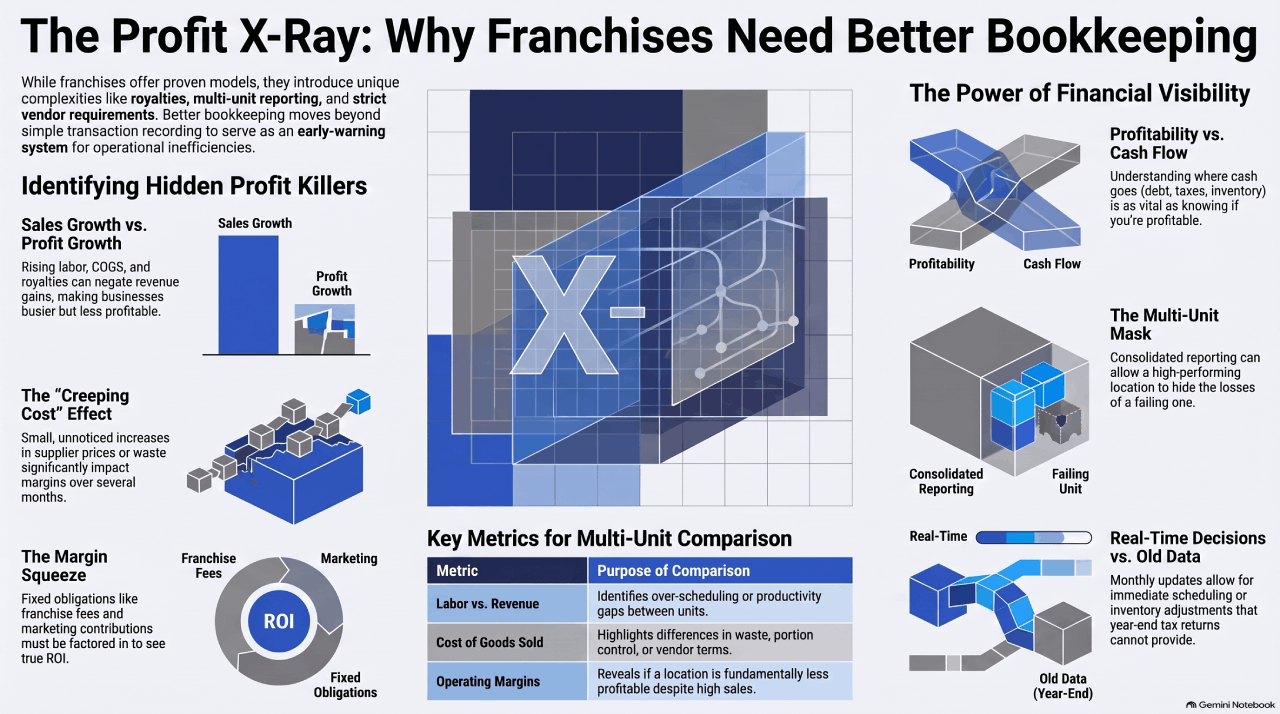
The problem is that sales growth and profit growth are not the same thing.
As revenue increases, so can:
- Labor costs
- Cost of goods sold
- Franchise royalties
- Advertising fees
- Merchant processing fees
- Delivery platform fees
- Utilities
- Repairs and maintenance
- Other operating expenses
If those costs increase faster than revenue, the business can become busier without becoming significantly more profitable.
Reliable bookkeeping for franchises allows you to compare revenue growth with expense and margin trends instead of assuming that higher sales automatically mean a healthier business.
2. You Cannot Explain Where the Cash Went
A franchise can show a profit and still struggle with cash flow.
This often confuses owners because the income statement may suggest that the business is performing reasonably well while the bank balance tells a different story.
There can be many reasons for this.
Cash may be going toward debt repayments, equipment purchases, taxes, inventory, owner distributions or other obligations that are not immediately obvious when you look only at sales.
The important question is not simply, “Did we make a profit?”
It is also, “What happened to the cash?”
A good bookkeeper for franchises should help maintain financial records that allow you to understand both profitability and the movement of cash through the business.
When you have that visibility, you can start planning ahead rather than constantly reacting to the balance in your bank account.
3. Food, Inventory or Other Direct Costs Are Creeping Up
For restaurant and retail franchise owners in particular, relatively small changes in direct costs can have a significant impact on profitability.
- Supplier prices increase.
- Waste goes unnoticed.
- Portion sizes change.
- Inventory controls become inconsistent.
- Discounting increases.
- Vendor terms change.
Any one of these may appear manageable in isolation. Over several months, however, the effect can become substantial.
Good franchise bookkeeping services should make it easier to track important expense categories consistently and identify unusual changes.
Your financial reports may not tell you exactly why food costs increased, for example, but they can tell you that something changed.
That gives you a starting point for investigating the operational cause.
4. Labor Costs Are Increasing Faster Than Revenue
Labor is another area where franchise owners need context.
Simply knowing that payroll increased does not tell you whether there is a problem.
If sales increased significantly at the same time, the additional labor may be entirely justified.
But if labor costs are rising while revenue remains relatively flat, you need to understand why.
Potential issues could include:
- Too many employees scheduled during slower periods
- Excessive overtime
- Poor scheduling practices
- Changes in wage rates
- Management staffing that no longer matches the needs of the location
- Differences in productivity between locations
Accurate bookkeeping gives you the financial foundation to compare labor with sales over time.
The numbers identify the trend. You can then investigate what is happening operationally.
5. One Location Is Hiding Behind Another
This becomes especially important when franchise owners expand to multiple units.
Suppose you own three locations and the group generates a healthy overall profit.
At first glance, everything may appear to be working.
But what if Location A is performing exceptionally well, Location B is average and Location C is consistently losing money?
If you only review consolidated results, the strength of Location A can hide the weakness of Location C.
Effective bookkeeping for franchises should allow multi-unit owners to see financial performance at the location level as well as across the entire business.
You can then compare:
- Sales
- Labor
- Cost of goods sold
- Operating expenses
- Profit margins
- Cash flow
Those comparisons can lead to much better questions.
- Why is one location more profitable?
- Why does another have higher labor costs?
- Are vendor costs different?
- Is management performance contributing to the difference?
- Is the location itself fundamentally less profitable?
The goal is not simply to rank your locations. It is to understand what the differences can teach you.
6. Franchise Fees and Other Obligations Are Squeezing Margins
Franchise owners operate within a financial structure that independent businesses do not necessarily have.
Depending on your franchise agreement, you may have royalty payments, marketing contributions, technology costs or other required fees.
These costs need to be considered when evaluating the true profitability of the business.
A location can generate impressive sales while producing a relatively disappointing return once all of its obligations are taken into account.
This is another reason franchise owners should focus on margins rather than revenue alone.
Your bookkeeping should make it easy to see the full cost structure of the business so you understand what you are actually keeping from every dollar of revenue.
7. You Are Making Decisions Based on Old Numbers
Good financial information loses much of its usefulness when it arrives too late.
If you discover months later that labor costs increased significantly, there is nothing you can do about the schedules you already ran.
If you only discover at year-end that a particular expense category has been steadily increasing, you have lost months in which you could have investigated it.
Tax returns tell you what happened historically.
Management decisions require more current information.
That is why timely franchise bookkeeping services can be so valuable.
When your books are consistently updated and reviewed, you have a better chance of identifying financial changes while you can still do something about them.
8. You Do Not Know Whether You Can Afford to Expand
Opening another franchise location is a major financial decision.
Strong sales at your existing location can make expansion feel like the obvious next step, but sales alone should not determine whether the business is ready.
Before expanding, you need a clear understanding of questions such as:
- How much cash does the existing business generate?
- How dependent is the business on debt?
- What are your current operating margins?
- How much working capital will another location require?
- Can the existing operation support additional management costs?
- What happens if the new location takes longer than expected to become profitable?
Reliable bookkeeping for franchises provides much of the historical information needed to start answering these questions.
From there, forecasting and advisory work can help you model what expansion could mean for the business.
9. Tax Season Becomes a Cleanup Exercise
If your financial records are incomplete or inconsistent throughout the year, tax season can become unnecessarily difficult.
- Transactions need to be corrected.
- Accounts need to be reconciled.
- Questions arise about expenses from months earlier.
- Documents need to be located.
And instead of using your financial information to plan ahead, everyone is focused on reconstructing what already happened.
Keeping the books current throughout the year creates a much stronger foundation for tax preparation and tax planning.
This is particularly important for franchise owners operating multiple entities or locations, where financial complexity can increase quickly.
A bookkeeper for franchises who understands how your business is structured can help maintain cleaner records throughout the year rather than leaving everything until tax season.
10. You Have Financial Reports but Still Do Not Know What to Do Next
Sometimes the problem is not a lack of financial reports.
It is a lack of clarity.
You receive an income statement and balance sheet every month, but you are not sure what has changed, what deserves attention or what action you should take.
That is where bookkeeping starts connecting with higher-level financial management.
Good books give you reliable historical information.
From there, you can use that information to:
- Build budgets
- Forecast cash flow
- Compare actual performance with expectations
- Evaluate pricing
- Analyze profitability
- Plan expansion
- Prepare for taxes
- Make strategic decisions
The bookkeeping itself does not make those decisions for you.
It gives you a reliable financial foundation from which to make them.
Franchisee Fortune:
A Book for Franchise Owners Who Want Profit, Clarity, and Control

Better Bookkeeping Helps You See Problems Earlier
The value of good bookkeeping is not simply having clean records.
It is having financial information you can trust when you need to make a decision.
As a former franchise owner, I know how much of your attention is already consumed by employees, customers, vendors and day-to-day operations. It is easy to focus on what is immediately in front of you and assume that strong sales mean the financial side of the business is working.
Sometimes it is.
Sometimes the numbers are telling a different story.
At Jebran & Abraham, P.C., our team provides franchise bookkeeping services designed to give franchise owners greater clarity around their financial performance. We understand the numbers from an accounting perspective, but we also understand what it is like to operate a franchise and make decisions when your own money is on the line.
If you are growing but cannot confidently explain where the money is going, which locations are performing best or what is driving your margins, better bookkeeping may be the place to start.
Talk to our team about bookkeeping and financial support for your franchise.
FAQs
Why is bookkeeping important for franchise owners?
Good bookkeeping for franchises gives owners reliable information about revenue, expenses, margins, cash flow and location-level performance. It can also provide a stronger foundation for tax planning, budgeting, forecasting and expansion decisions.
For a closer look at the mistakes that can affect franchise profitability, read Franchise Accounting Services: The Biggest Financial Mistakes Franchise Owners Make.
What should multi-unit franchise owners expect from their bookkeeping?
Multi-unit owners should be able to evaluate both consolidated performance and individual locations. Consistent reporting can help identify differences in sales, labor, costs, expenses and profitability across the portfolio.
We explore this specifically in Franchise Bookkeeping Services for Multi-Unit Owners: Managing Growth With Financial Clarity.
What is the difference between franchise bookkeeping and franchise accounting?
Bookkeeping generally focuses on maintaining accurate financial records and categorizing transactions. Accounting can involve broader financial reporting, tax compliance, tax planning and analysis. As a franchise grows, owners may benefit from having these functions work together rather than treating them as completely separate activities.
Learn more about the broader role of a Franchise CPA and why franchise-specific experience can matter.
Can better bookkeeping help a franchise improve profitability?
Better bookkeeping does not automatically make a business more profitable, but it gives owners greater visibility into the factors affecting profit. This can include labor, cost of goods sold, franchise fees, operating expenses and differences between locations. With reliable information, owners are better positioned to identify issues and make informed changes.
Restaurant franchise owners can also read Restaurant Accounting Solutions That Improve Profitability for a closer look at how financial management can support stronger margins.
When does a franchise owner need CFO-level support?
Bookkeeping primarily tells you what has already happened. As the business becomes more complex, owners may need forward-looking support with budgeting, forecasting, cash flow planning, expansion scenarios and profitability analysis. That is where CFO and advisory services can become valuable.
For restaurant franchise operators, What a Fractional CFO for Restaurants Sees That Most Owners Miss explains how this type of financial oversight differs from basic bookkeeping.
Can bookkeeping help when opening another franchise location?
Yes. Reliable historical bookkeeping can help you understand the profitability, cash generation and cost structure of your existing locations before committing capital to another unit. Expansion decisions should then incorporate forecasting, expected startup costs, working capital requirements and different performance scenarios.
For multi-unit owners, the goal is not simply to add locations. It is to build a portfolio in which you understand how each location contributes to the financial performance of the overall business.